Global Financial Private Client LLC increased its position in shares of Microsoft Corporation (NASDAQ:MSFT - Free Report) by 10.7% during the first quarter, according to the company in its most recent 13F filing with the SEC. The firm owned 17,993 shares of the software giant's stock after buying an additional 1,737 shares during the quarter. Microsoft comprises about 2.2% of Global Financial Private Client LLC's portfolio, making the stock its 4th biggest position. Global Financial Private Client LLC's holdings in Microsoft were worth $6,660,000 at the end of the most recent reporting period.
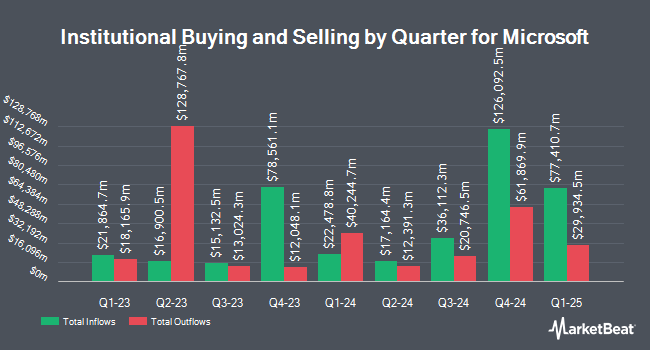
Several other institutional investors and hedge funds have also added to or reduced their stakes in MSFT. Longfellow Investment Management Co. LLC grew its position in Microsoft by 51.3% in the 2nd quarter. Longfellow Investment Management Co. LLC now owns 59 shares of the software giant's stock valued at $29,000 after purchasing an additional 20 shares during the period. Bernzott Capital Advisors acquired a new position in Microsoft during the fourth quarter worth $34,000. Timmons Wealth Management LLC bought a new position in shares of Microsoft in the fourth quarter valued at $36,000. Fairway Wealth LLC lifted its stake in shares of Microsoft by 287.0% in the fourth quarter. Fairway Wealth LLC now owns 89 shares of the software giant's stock valued at $43,000 after buying an additional 66 shares in the last quarter. Finally, LSV Asset Management acquired a new position in shares of Microsoft during the fourth quarter valued at about $44,000. Institutional investors own 71.13% of the company's stock.
Analyst Ratings Changes
MSFT has been the topic of a number of analyst reports. Sanford C. Bernstein upped their target price on shares of Microsoft from $641.00 to $646.00 and gave the stock an "outperform" rating in a report on Thursday, April 30th. HSBC cut their price target on Microsoft from $593.00 to $571.00 in a research note on Thursday, April 30th. Truist Financial decreased their price objective on Microsoft from $675.00 to $575.00 and set a "buy" rating for the company in a report on Thursday, April 30th. DZ Bank reissued a "buy" rating on shares of Microsoft in a research note on Thursday, April 30th. Finally, Jefferies Financial Group restated a "buy" rating on shares of Microsoft in a report on Monday, May 4th. Forty-one investment analysts have rated the stock with a Buy rating and six have given a Hold rating to the company's stock. According to data from MarketBeat.com, the company has an average rating of "Moderate Buy" and an average target price of $560.86.
Check Out Our Latest Stock Report on Microsoft
Key Headlines Impacting Microsoft
Here are the key news stories impacting Microsoft this week:
- Positive Sentiment: Haleon signed a new five-year collaboration with Microsoft to expand use of its AI, cloud, and data technologies, underscoring continued enterprise adoption of Microsoft’s AI stack. Article Title
- Positive Sentiment: A Jefferies CIO survey showed Azure widening its lead over AWS among U.S. CIOs, supporting the case that Microsoft’s cloud momentum remains intact. Article Title
- Positive Sentiment: Analysts remain constructive on the stock, with JMP Securities reaffirming an Outperform view after Copilot Cowork’s launch and other coverage pointing to Microsoft’s AI growth potential. Article Title
- Neutral Sentiment: Microsoft is still drawing investor attention as a long-term AI winner, but several commentary pieces argue the stock is also under pressure from higher valuation scrutiny and broad Magnificent 7 weakness. Article Title
- Negative Sentiment: Reports that Microsoft may cut thousands of jobs, including in Xbox, sales, and consulting, are fueling concern that heavy AI spending is pressuring margins and forcing cost reductions. Article Title
- Negative Sentiment: Investor class-action notices tied to alleged Copilot/Azure misrepresentations are adding legal overhang and keeping sentiment cautious around MSFT. Article Title
Insider Buying and Selling
In other news, EVP Amy Coleman sold 1,262 shares of the company's stock in a transaction on Thursday, May 14th. The stock was sold at an average price of $411.34, for a total transaction of $519,111.08. Following the transaction, the executive vice president owned 46,003 shares of the company's stock, valued at $18,922,874.02. This represents a 2.67% decrease in their position. The sale was disclosed in a filing with the Securities & Exchange Commission, which is available at the SEC website. Also, CEO Judson Althoff sold 15,500 shares of the business's stock in a transaction dated Monday, June 1st. The shares were sold at an average price of $460.99, for a total value of $7,145,345.00. Following the completion of the sale, the chief executive officer owned 110,477 shares in the company, valued at $50,928,792.23. This represents a 12.30% decrease in their ownership of the stock. The disclosure for this sale is available in the SEC filing. In the last quarter, insiders have sold 23,762 shares of company stock valued at $10,508,361. 0.03% of the stock is owned by company insiders.
Microsoft Price Performance
MSFT opened at $384.28 on Thursday. The firm has a market cap of $2.85 trillion, a P/E ratio of 22.87, a PEG ratio of 1.34 and a beta of 1.13. The firm has a 50-day moving average of $407.66 and a 200 day moving average of $418.67. The company has a debt-to-equity ratio of 0.08, a quick ratio of 1.27 and a current ratio of 1.28. Microsoft Corporation has a fifty-two week low of $349.20 and a fifty-two week high of $555.45.
Microsoft (NASDAQ:MSFT - Get Free Report) last announced its quarterly earnings data on Wednesday, April 29th. The software giant reported $4.27 EPS for the quarter, topping the consensus estimate of $4.06 by $0.21. The business had revenue of $82.89 billion for the quarter, compared to analyst estimates of $81.44 billion. Microsoft had a net margin of 39.34% and a return on equity of 31.94%. The company's revenue for the quarter was up 18.3% on a year-over-year basis. During the same quarter in the previous year, the firm posted $3.46 earnings per share. On average, research analysts expect that Microsoft Corporation will post 16.76 EPS for the current year.
Microsoft Announces Dividend
The business also recently declared a quarterly dividend, which will be paid on Thursday, September 10th. Stockholders of record on Thursday, August 20th will be paid a dividend of $0.91 per share. The ex-dividend date is Thursday, August 20th. This represents a $3.64 annualized dividend and a dividend yield of 0.9%. Microsoft's dividend payout ratio (DPR) is presently 21.67%.
Microsoft Profile
(
Free Report)
Microsoft Corporation is a global technology company headquartered in Redmond, Washington. Founded in 1975 by Bill Gates and Paul Allen, Microsoft develops, licenses and supports a broad range of software products, services and devices for consumers, enterprises and governments worldwide. Its operations span personal computing, productivity software, cloud infrastructure, enterprise applications, developer tools and gaming.
Microsoft's product portfolio includes the Windows operating system and the Microsoft 365 suite of productivity and collaboration tools (Office apps, Outlook, Teams).
Featured Articles
This instant news alert was generated by narrative science technology and financial data from MarketBeat in order to provide readers with the fastest reporting and unbiased coverage. Please send any questions or comments about this story to contact@marketbeat.com.
Before you consider Microsoft, you'll want to hear this.
MarketBeat keeps track of Wall Street's top-rated and best performing research analysts and the stocks they recommend to their clients on a daily basis. MarketBeat has identified the five stocks that top analysts are quietly whispering to their clients to buy now before the broader market catches on... and Microsoft wasn't on the list.
While Microsoft currently has a Moderate Buy rating among analysts, top-rated analysts believe these five stocks are better buys.
View The Five Stocks Here
Robotics and automation are rapidly becoming essential infrastructure across healthcare, manufacturing, logistics, and many other industries.
"Physical AI" is coming to the United States, and there are four ways that investors can gain exposure to this new robotics revolution. Plus, learn which seven companies are most positioned to benefit as intelligent robots enter the workforce.
Get This Free Report
