AI bubble or not, demand trends suggest this bubble continues to grow and has no end in sight. The news in early April is that GPU rental prices are skyrocketing, and underpinning a robust outlook for GPU-as-a-Service providers. The group spans a diverse array of businesses with one thing in common: they all own or have access to NVIDIA NASDAQ: NVDA AI-capable GPU clusters at scale, rent them out on an on-demand or long-term basis, and benefit from a dynamic pricing model.
Dynamic pricing, in this case, simply means that demand and supply vectors align in a way that drives pricing power. Pricing power for investors means an enhanced revenue and earnings outlook, factors that drive stock prices higher. As it stands, reports show H100 and H200 pricing increasing by 40% as of March, and pricing for newer Blackwell and upcoming Vera Rubin models rising by 50% or more as of April. Demand is so high, operators are starting to turn away short-term on-demand business in favor of longer-term, highly visible contracts that enable them to leverage capital markets, invest in growth, and expand.
And demand is there. Reports also include delayed plans from major AI labs and hyperscalers. A lack of capacity underpins their decisions, in turn driving a robust outlook for the data center, GPUs, and the GPU-as-a-Service industry. The primary delays are in training. Persistent capacity shortages linked to inference impair the training of large models. Shortages are likely to continue for the foreseeable future, as HBM memory is the heart of the problem. HBM memory is critical to AI GPU construction, with each GPU requiring numerous stacks and each HBM stack utilizing numerous chips. As it stands, HBM capacity is ramping but is not expected to significantly improve the scenario until well into 2027.
Play #1: Memory Chip Makers
Memory is at the heart of the GPU shortage, and Micron NASDAQ: MU is among the best-positioned. Not only are its HBM modules considered top-tier, if not the best, for AI modeling and inference, but it is well along with its expansion plans. The company has several projects underway to improve its supply chain while bolstering its domestic footprint, many of which are expected to come online in 2027 and subsequent years. Until then, revenue and earnings are growing at a high triple-digit pace, accelerating, and estimates are rising. The forecasts are underpinned by shortages, with Micron reportedly sold out of HBM through 2027, and higher pricing.
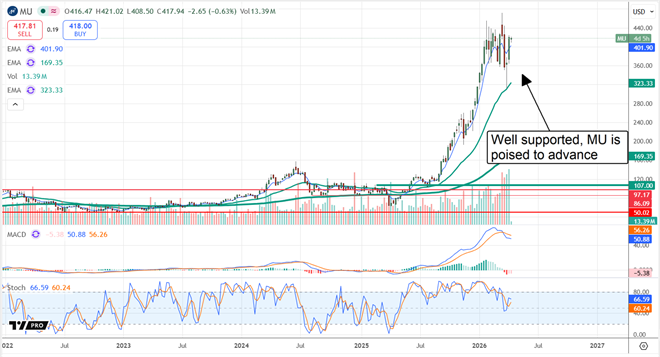
Micron’s analyst sentiment trends are robust. MarketBeat tracks 37, sufficient for a high-conviction rating; coverage has been increasing, and they peg the stock at Buy. The Buy-side bias also reflects conviction, with 90% of the ratings pegged at Buy or higher. The consensus price target assumed only 10% upside as of mid-April, but the trend remains robust, with the most recent targets suggesting at least 20% upside from the critical resistance at $450.
Play #2: GPU Chip Makers (That Aren’t NVIDIA)
NVIDIA is well-positioned to ramp production and claim revenue, but it may not be the best choice. While Advanced Micro Devices’ NASDAQ: AMD capabilities have lagged NVIDIA’s, it is on the brink of launching a new line, including rack-scale solutions and the software stack to run them.
AMD’s open-sourced system is designed to compete directly with NVIDIA’s CUDA, setting the stage for it to take data center share. Because its chips are viewed as better for inference and expected to provide considerable cost savings, AMD stands to sell out of its products quickly, with the impact spilling over into and boosting the data center and GPU-as-a-Service market in the longer term.
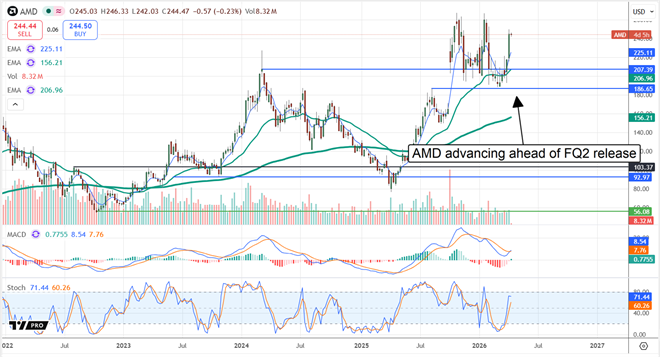
Companies with deals for MI450 products announced include Meta Platforms NASDAQ: META, OpenAI, and Oracle NASDAQ: ORCL. Each intends to use the GPUs to power high-capacity, high-power computing centers for AI development and inference. Analysts are bullish on the outlook, expecting revenue growth to accelerate sequentially over the next four to six quarters, and are lifting stock price targets ahead of the fiscal Q2 2026 earnings release. MarketBeat data shows 40 analysts covering AMD, a Moderate Buy consensus, and a potential 20% to 55% upside.
Play #3: GPU-as-a-Service Providers
GPU-as-a-Service providers are clear winners, with pricing that drives revenue and earnings. Names like CoreWeave NASDAQ: CRWV, Applied Digital NASDAQ: APLD, Nebius Group NASDAQ: NBIS, and IREN Limited NASDAQ: IREN all qualify, though each has unique properties. CoreWeave may be the best-positioned, with more than 30 data centers in operation across the EU and U.S., but the others also stand to win.
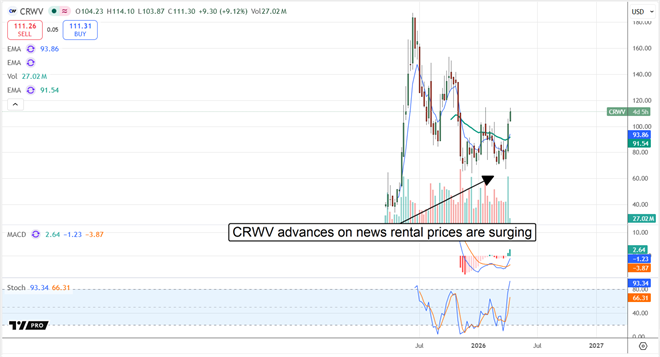
The biggest hurdle for the companies is the buildout, but it is underway. The biggest hurdle for investors is the cost of the build-out, which is being underpinned by debt and dilutive forces. Factors suggesting limited risk include swelling backlogs, with Nebius Group a prime example. Its debt load swells in 2026, with total liabilities approaching $8 billion by early 2026, but it is backed by a backlog of more than $45 billion.
Before you consider CoreWeave, you'll want to hear this.
MarketBeat keeps track of Wall Street's top-rated and best performing research analysts and the stocks they recommend to their clients on a daily basis. MarketBeat has identified the five stocks that top analysts are quietly whispering to their clients to buy now before the broader market catches on... and CoreWeave wasn't on the list.
While CoreWeave currently has a Moderate Buy rating among analysts, top-rated analysts believe these five stocks are better buys.
View The Five Stocks Here
MarketBeat's analysts have just released their top five short plays for May 2026. Learn which stocks have the most short interest and how to trade them. Click the link to see which companies made the list.
Get This Free Report
Like this article? Share it with a colleague.
Link copied to clipboard.
